Abstract briefs produce irrelevant stock
Image libraries and generative tools interpret broad nouns through popular visual shorthand. “AI” produces robots, glowing brains, neon networks, and fake dashboards. “Architecture” produces buildings and blueprints. “Research” produces laboratories and libraries. Each is visually legible and strategically wrong for product engineering.
The problem is not only taste. The image points the buyer toward the wrong capability and can make precise service copy feel like a template.
Name the artifact, action, and context
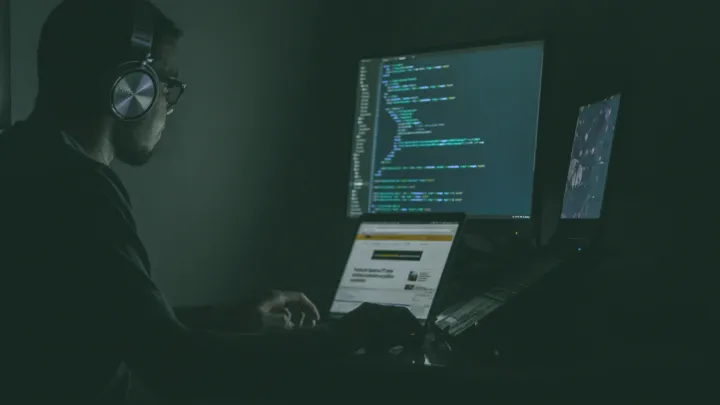
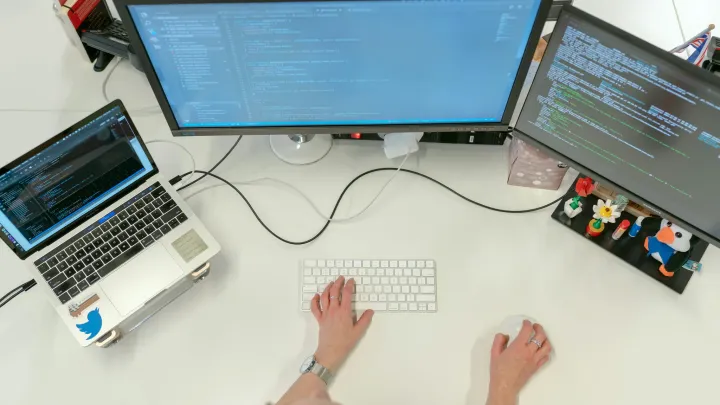
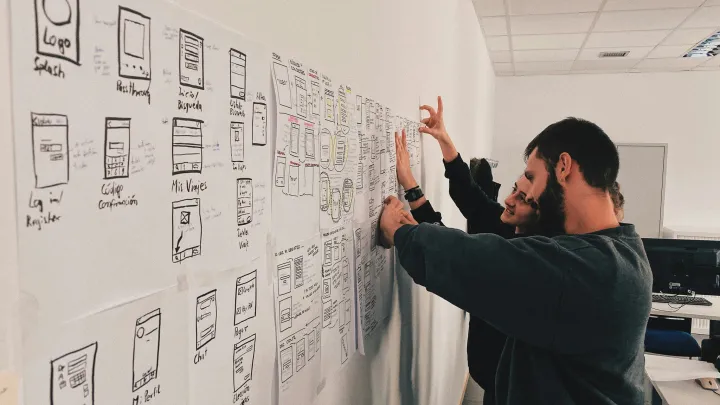
A strong brief identifies what must be visible, what the person is doing, and why that scene belongs beside the message. For applied AI, show code, evaluation output, controlled data work, or a human review surface. For custom software, show product interfaces and implementation. For architecture, show system or application flows being reviewed. For discovery, show decision artifacts being created.
Add exclusions: no robots, handshakes, generic teams, physical blueprints, neon “AI” overlays, or dashboards that could belong to any industry. Exclusions prevent a technically correct but strategically empty result.
Distinguish context from proof
Stock photography can establish the domain and pace a page. It cannot prove that the subject works for the company, that the screen is a client system, or that the depicted outcome occurred. Alternative text should describe the photograph literally; captions may connect it to an engineering principle without converting it into a claim.
Real product screenshots, architecture diagrams, case artifacts, testimonials, and measured outcomes belong in a separate proof system with provenance and context.
Audit the crop in the actual layout
A relevant source image can become weak after cropping. Verify the desktop and mobile focal point, text legibility inside screens, visual noise, colour interaction, loading weight, and whether the image still communicates the intended artifact at small size.
Host approved assets locally, resize to the largest rendered need, use a modern compressed format, declare width and height, and lazy-load below-fold media. Record source and photographer attribution in the design documentation even when public credit is not required.
Use a visual evidence matrix
Review the set together. Six individually acceptable images can still feel repetitive or visually incoherent. Balance light and dark scenes, people and artifacts, close and wide compositions, while keeping the technical domain unmistakable.
- Decision to production: active code and terminal surfaces in one working context.
- Applied AI: evaluation, run output, data analysis, source comparison, or human review.
- Custom software: developer working with code and a real product surface.
- Architecture: application flows, integrations, boundaries, or system decisions being reviewed.
- Opportunity Sprint: workflow and interface artifacts being mapped collaboratively.
- Insights: inspectable technical source material rather than a generic library.
The credibility test
Remove the heading and ask what discipline the image depicts. If the answer could be finance, architecture, biotech, or generic consulting, the brief is not specific enough. Then restore the heading and ask whether the image supports the statement without pretending to be evidence it is not.
This process is one part of a broader proof-led website system. Custom software engineering and applied AI pages should still earn trust through method, decisions, and case evidence, not photography alone.