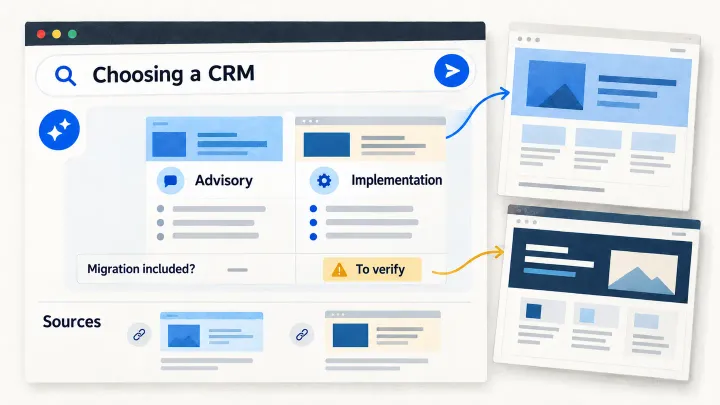
A company needs a provider to replace its customer-management software. It wants to transfer its history, train twelve salespeople in French and English, and connect the new system to accounting. It asks an AI assistant to help compare the options.
This fictional example requires several kinds of information. Product documentation may confirm an accounting connection. A service page can explain who transfers the data. A published case can show what a provider contributed to a real project.
Your website needs to answer the part of the request on which your business can provide reliable information.
An assistant does not necessarily search the web for every answer
The model producing the text has knowledge acquired during its training. Depending on the service and mode, it may also receive documents or search for information when answering. Check which functions were used before assuming it read your website.
In a method called retrieval-augmented generation, or RAG, the system first retrieves relevant documents. It then supplies them to the model to help answer the question. Errors remain possible. Google Cloud’s explanation
Google also says its generative search features may run several related searches for one question. Finding a provider might therefore involve information about its services and the software involved. This is a mechanism documented by Google, not a description of every assistant. Google Search documentation
Give each page a clear job
For our fictional company, a general article about the benefits of customer-management software leaves several questions unanswered. The buyer still needs to know who will handle the work.
| What the customer needs to check | Where a useful answer belongs |
|---|---|
| Can the software exchange data with accounting? | Documentation for the products and versions being used. |
| Who prepares, transfers and checks the existing data? | A service page that explains the work and responsibilities. |
| Will employee training be available in both languages? | The conditions of the training service. |
| What work has the provider done before? | A real case describing the context, its role and the observed result. |
Improve the page that should answer the question first. If bilingual training is part of your service, state that there. Another general software article will leave that condition unclear.
Read what the link actually supports
Suppose an assistant links to your article to explain what a data transfer involves. Your page is presented as a source, often called a citation. That does not mean the assistant recommends your company to carry out the transfer.
A mention means your name appears. A recommendation means the assistant proposes your company for the stated need. You may observe one, two or all three in the same answer.
Open the link and compare the answer with the page. Check the conditions that matter: included services, area served and the date of the information. A link does not prove that every nearby sentence came from that page. When no link is shown, you cannot infer that the assistant consulted your new article.
Find the information behind a confusing description
If an answer says your business offers bilingual training when it does not, look for the origin of that statement. Is your page ambiguous? Does an old listing still advertise the training? Does the displayed link describe a different provider?
Correct what you can verify. If you cannot find the source of the error, record that uncertainty. A suspected cause is too little to justify rebuilding the website.
A source’s date also needs to fit its subject. A list of software connections may become outdated after a product update. An older explanation may remain useful if its conditions are still true. Changing a page’s date alone does not update its content.
Run a first check you can review later
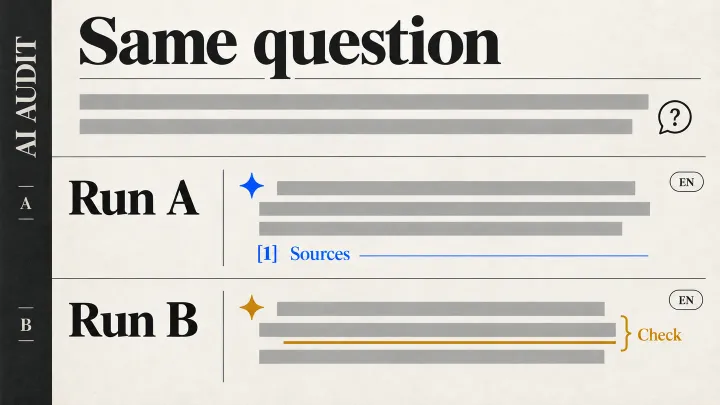
Choose one buying question. Keep its exact wording, the assistant’s name, the mode used and the date. Save the complete answer and links, then repeat the question under comparable conditions.
A recurring error gives you a specific problem to investigate. If the answers vary, keep that variation too. One good answer or one absence cannot establish your company’s overall visibility.
The next article helps you choose questions from conversations with your customers.
See all ten articles on how your business appears in AI answers
Was this article useful to you?
Your feedback goes privately to TechnoConception. No account or email is required.
How this feedback is handled
Responses expire after 90 days. They are not published or used as sales enquiries. A daily pseudonymous network identifier expires after 24 hours to limit abuse. Expired records are deleted by an hourly cleanup. The feedback database does not store your IP address; hosting security logs may still process it.
This browser stores only a receipt and your rating until the response expires, to reduce accidental duplicates. It does not store your comment or editing key. You can update a response during this page visit; after leaving, it becomes read-only in this browser.
Privacy policy