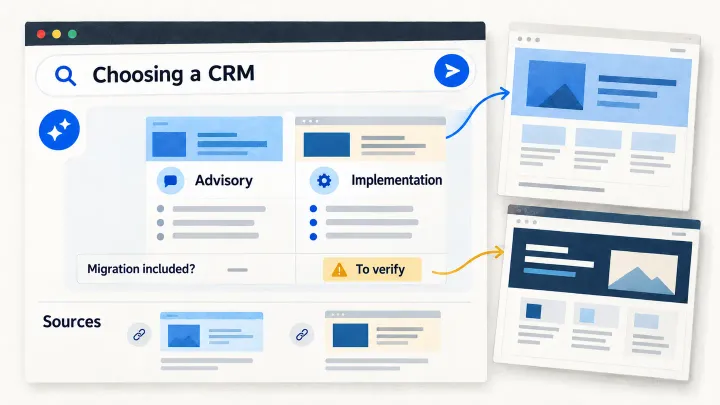
Consider a fictional company maintaining commercial refrigerators in the Québec City area. It wants to know whether AI assistants suggest it to restaurants looking for that service.
Two checks produce different results. In the first answer, the company is absent. In the second, it appears but is described as repairing domestic refrigerators, a service it does not offer. These observations need different responses. An absence calls for further investigation; the incorrect description may already send a customer toward the wrong service.
The method below keeps enough information to understand each result.
Separate discovery from checking a known name
“Who maintains commercial refrigerators in Québec City?” asks the assistant to find businesses. “What services does [company name] offer?” supplies the name to describe.
The second question can uncover a useful error to fix. It does not show whether a buyer would have discovered the company without knowing its name. Keep results from the two types of question separate.
We suggest starting with twelve questions: four about the need and possible providers, four about comparing options and four about conditions to check before choosing. This is a proposed working method, not an industry standard.
Use questions your team has received. Note whether each one needs a general explanation or a provider suggestion. A question about equipment maintenance can receive a good answer without naming any business.
Keep the first check small enough to review
Choose one assistant, one language and the twelve questions. Ask each question twice in separate conversations. You will have 24 answers to review if every attempt succeeds.
Start a new conversation for each question to limit the influence of earlier exchanges. Use the same mode, such as web search, and record the account’s known location. These steps improve comparability; they do not eliminate personalization.
Save the exact question, date, service, mode and complete answer with its links. Record the model name if it is displayed. Leave it unknown if it is not.
An unavailable service or a technical error is a missing attempt. It does not mean your business was absent from an answer. On Google, a search that produces no AI Overview is a separate outcome again: there is no generated answer to inspect.
Read the answers before calculating a percentage
For each answer received, fill in a few plain columns:
| Column | What to record |
|---|---|
| Business name | Does it appear in the text? |
| Link to your website | Which page is offered as a source? |
| Recommended service | Does the assistant actually propose your business for the request? |
| Accurate description | Are the services, customers and area served correct? |
| Issue to investigate | Which sentence is misleading, and which page might explain it? |
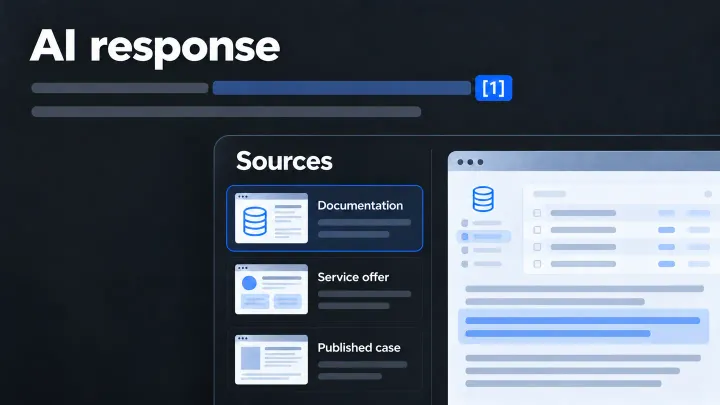
A “citation” here means a link supplied as a source. A citation of your article may simply explain preventive maintenance. It does not necessarily recommend your company.
Retain unfavourable answers and contradictions too. Selecting only the best answer would misrepresent the checks.
State exactly what the result measures
In a fictional example, 24 attempts produce 20 answers and 4 technical errors. The business is named in 6 of the 20 answers, giving 30%. Show the 4 failed attempts separately. The calculation uses the 20 answers received.
For Google, also separate the proportion of searches that produce an AI Overview from your company’s presence within those overviews. Combining the two would hide the reason for a change.
This percentage describes your questions and test conditions. It is neither market share nor the proportion of all customers who see you. Adding questions that contain your name can increase the number without improving discovery.
Use the same questions next time. If you need to add questions, keep a separate list or declare a new version of the test.
Expand only when the work is useful
You can later compare several services, such as ChatGPT with search, Perplexity, Copilot and one specific Google experience. Choose AI Mode or AI Overviews according to availability; count them separately if you test both.
Twelve questions, four services, two languages and three repetitions produce 288 attempts. That can require substantial reading. It does not represent 288 buyers or make the questions representative of the market.
If a tool automates the work, ask whether it uses public applications or an API, a connection intended for software. API results do not automatically reproduce what a customer sees in an application. Require access to the answers and their links for review.
Turn the observation into a task
For our refrigeration company, the first task would be to investigate the domestic-repair claim. Open the displayed sources. Correct an old listing or an ambiguous page if you find the error. If its origin remains unknown, record that uncertainty.
Assign the correction to someone and keep its publication date. Repeating the same checks lets you observe what happens next, without guaranteeing that an assistant immediately adopts the new information.
The workbook provides a place to keep answers and track corrections. The following articles explain technical checks and page revisions.
See all ten articles on how your business appears in AI answers
Was this article useful to you?
Your feedback goes privately to TechnoConception. No account or email is required.
How this feedback is handled
Responses expire after 90 days. They are not published or used as sales enquiries. A daily pseudonymous network identifier expires after 24 hours to limit abuse. Expired records are deleted by an hourly cleanup. The feedback database does not store your IP address; hosting security logs may still process it.
This browser stores only a receipt and your rating until the response expires, to reduce accidental duplicates. It does not store your comment or editing key. You can update a response during this page visit; after leaving, it becomes read-only in this browser.
Privacy policy