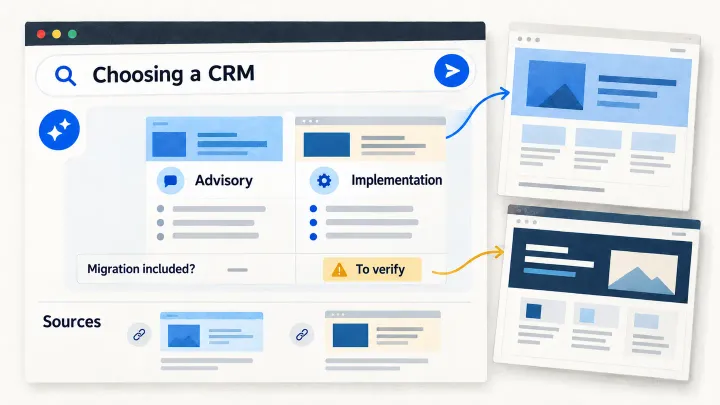
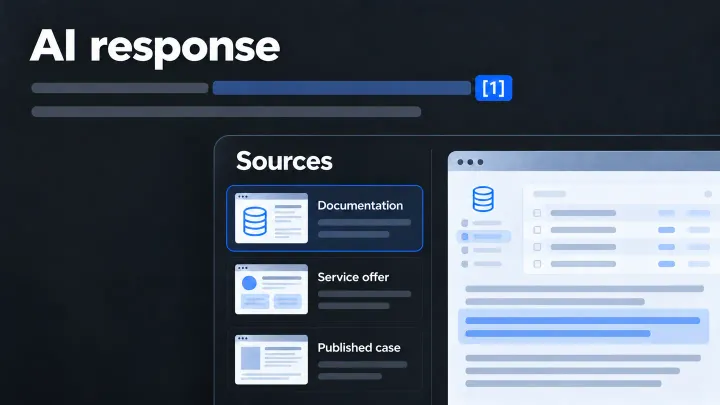
A company improves its pages so AI assistants can describe it more accurately. It then wants to know whether the work helps it find customers.
Start with the enquiries received. A submitted form may contain a suitable project, a supplier’s sales pitch or a request for a service the company does not provide. Counting every message as a potential customer would misrepresent the result.
Define an enquiry that fits your business
Agree on the criteria with the person who speaks with prospects. A suitable enquiry might come from a business in your service area, describe work you undertake and provide enough information for an initial project discussion.
Sales teams often call this a qualified enquiry once those checks have been made. Define the term for your business before filling in the table. A request still awaiting review should keep that status.
Then distinguish a promising conversation, a proposal sent and a signed contract. A prospect can fit your service while needing several months to decide.
Compare counts and percentages together
The following example is entirely fictional. Two sources of visits cover the same arrival period. Every visit has had an equal follow-up period, completed before the review. Each enquiry and customer is counted once, using a rule chosen before the comparison.
A “visit,” also called a session, can belong to someone who has visited before. The table therefore does not count unique people.
| In this fictional example | Visits identified as coming from an AI assistant | Visits from conventional search results |
|---|---|---|
| Visits | 100 | 1,000 |
| Enquiries received | 8 | 40 |
| Enquiries that fit the service | 3 | 12 |
| Those enquiries divided by visits | 3% | 1.2% |
| Signed customers | 1 | 4 |
The first group has the higher percentage. The second supplies four times as many suitable enquiries and signed customers. Both facts matter to a budget discussion.
The small counts need caution. One additional customer would change the first group substantially. These fictional figures explain a calculation; they predict no outcome for your business and do not establish the effect of a rewrite.
Keep what you know about how the customer found you
Your measurement tool may sometimes identify a visit from an AI assistant. Keep that information with the landing page and date, within your existing measurement setup and privacy rules.
You can also ask an optional question: “Where did you first discover our company?” Keep the answer in a separate field. It describes something different from the source recorded by the website.
A prospect may discover the company in an AI answer, then search its name on Google before getting in touch. The website may record a Google visit while the prospect describes discovering you through AI. Both observations can be consistent.
When the source is unknown, leave it unknown. A visit without an identifiable source cannot automatically be assigned to AI. Multiple visits by one customer also do not create multiple contracts.
Connect each enquiry with its outcome
In your customer-tracking software, or a spreadsheet if sufficient, record what happens: awaiting review, suitable for the service, declined, proposal in progress or signed contract. Add the reason when an enquiry does not fit.
Those reasons can help improve content. If readers repeatedly request installation when you sell advice, review the service page. If enquiries fit but remain open, allow for the actual decision process.
Compare groups that have had equal follow-up time. Last week’s enquiries cannot be judged like those with three months to develop. An open opportunity remains open at the review date.
Do not turn every measurement into a potential customer
Several separate events can be observed: a search program visits the website; a page appears in an answer; a person visits; an enquiry arrives; a contract is signed.
You will not always be able to connect every step. A crawler visit is not a buyer’s visit. A link appearing in your own test does not prove a customer saw it. Keep each number attached to what it actually measures.
Also record the dates of page revisions, campaigns and changes to the offer. An increase coinciding with a new campaign cannot be assigned entirely to the articles.
Decide from the enquiries and the effort spent
If descriptions become more accurate but enquiries remain rare, you can extend observation within an agreed time limit. If visits rise with unsuitable requests, clarify the offer. If relevant projects progress, examine their value and the cost of the work before increasing the budget.
Revenue associated with those customers is not automatically profit created by the rewrite. Costs and what would have happened without the work also matter. If you cannot estimate that difference, present observed results and spending separately.
The workbook connects enquiries with their follow-up. The next article organizes this work over three months, with intermediate decisions.
See all ten articles on how your business appears in AI answers
Was this article useful to you?
Your feedback goes privately to TechnoConception. No account or email is required.
How this feedback is handled
Responses expire after 90 days. They are not published or used as sales enquiries. A daily pseudonymous network identifier expires after 24 hours to limit abuse. Expired records are deleted by an hourly cleanup. The feedback database does not store your IP address; hosting security logs may still process it.
This browser stores only a receipt and your rating until the response expires, to reduce accidental duplicates. It does not store your comment or editing key. You can update a response during this page visit; after leaving, it becomes read-only in this browser.
Privacy policy