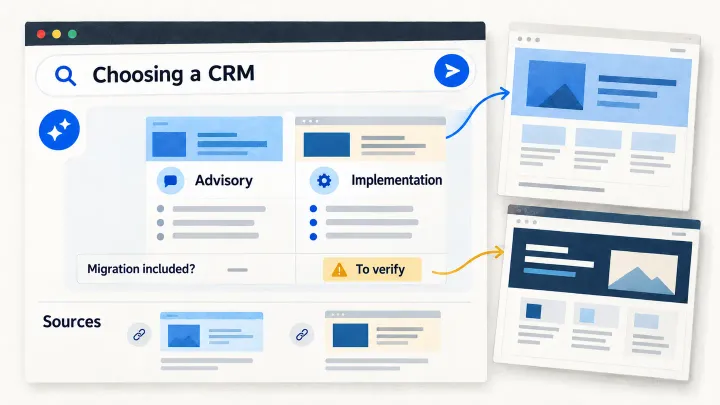
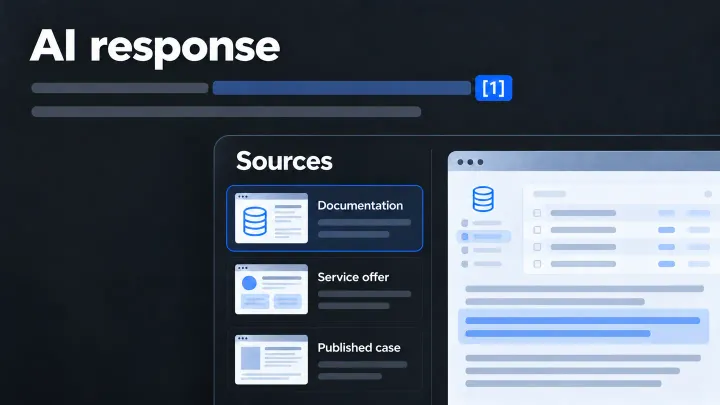
This plan is for a small team testing how to improve its presence in AI answers. It proposes a way to organize the work; it promises neither assistant recommendations nor revenue within 90 days.
Consider a fictional company maintaining refrigeration equipment for restaurants. It chooses its maintenance-contract page and an article helping restaurant owners compare those contracts. The aim is for buyers to understand the equipment covered, area served and work included.
Those two pages limit the first trial. The team can identify what changed and how much time it took.
Before starting, agree on the work and its limits
Name someone to coordinate the trial and, if needed, someone else to confirm service details. Set the available time before choosing a tool or publishing schedule.
As an example, a team might reserve twenty-four hours over the three months. This fictional cap must cover preparation, corrections, review and observation. Estimate your own work before adopting the number. A technical problem could make it unsuitable.
Also choose the questions to ask assistants. For an initial trial, twelve questions in one language, each asked twice in one service, produce 24 attempts and up to 24 answers to review. The checking guide explains that format. The expanded version with 288 attempts needs a separate time estimate.
Finally, agree on the decision to make after three months: continue the corrections, observe for longer or use the time on another priority.
First month: understand the current position
Collect questions actually received before a purchase. Separate those asking for provider suggestions from those already naming your business. Save the wording, service used, language and dates.
Read the answers. For our fictional company, a description claiming it repairs domestic refrigerators needs immediate investigation. Correct urgent errors without waiting until month-end, and record when you do so. You will know which corrections preceded the comparison.
Have access to both pages checked too. If a search program cannot read them, address that before interpreting an absence from an answer.
By the end of the month, you should have saved answers, selected pages to improve and people responsible for the work. If questions keep changing or pages remain inaccessible, reduce the trial and resolve that obstacle.
Second month: improve the selected pages
Address one kind of problem. In our example, both pages could clarify covered equipment, included visits and the restaurant owner’s responsibilities. Someone who knows the service checks the facts, then a new reader checks whether the offer makes sense.
Avoid simultaneously rebuilding the whole website, launching a campaign and publishing a video series for this trial. Several changes at once make it harder to understand what accompanies the results.
Record publication dates. Ask the same questions in the same languages and modes. Keep several answers, including those that contradict expectations. Other comparable pages left unchanged can provide an additional reference. Search services also evolve, so this comparison does not establish causation on its own.
At the second-month review, first confirm that the intended text is published and the checks are comparable. Sparse observations may justify waiting within the agreed limit. A measurement problem needs correction before drawing a conclusion.
Third month: examine enquiries and time spent
Repeat the questions to see whether the descriptions recur. Then review enquiries with identifiable sources alongside the person who speaks with customers.
For each enquiry, check whether the need fits the service. Keep its known outcome: conversation, proposal, decline or contract. A request still in progress becomes neither a sale nor a failure merely because three months have passed.
Compare what you learned with the actual time spent. More accurate descriptions can have value even with few enquiries. Repeated requests for the wrong service identify an explanation to revisit. If observations remain insufficient, state what is missing for a decision.
You can continue useful work, extend limited observation or stop an activity whose cost outweighs the information obtained. The criteria agreed at the start help avoid changing the objective to make the trial look successful.
Ask for a report you can understand
If a provider does the work, request the revised pages, exact questions, complete answers and dates. The report should include failed or unavailable attempts as well as good results.
Also ask whether measurements come from a public application or an automated API connection. An API lets software query a service; its output does not automatically reproduce a customer’s experience.
At the end, the review can fit on one page: changes made, recurring observations, enquiries received, time spent and next decision. Links to the answers and page versions let you inspect the details.
To discuss this work with TechnoConception, bring a service page and two or three questions received from customers. We can identify the information to examine and what an initial assessment should help you decide. The workbook can help prepare those items.
See all ten articles on how your business appears in AI answers
Was this article useful to you?
Your feedback goes privately to TechnoConception. No account or email is required.
How this feedback is handled
Responses expire after 90 days. They are not published or used as sales enquiries. A daily pseudonymous network identifier expires after 24 hours to limit abuse. Expired records are deleted by an hourly cleanup. The feedback database does not store your IP address; hosting security logs may still process it.
This browser stores only a receipt and your rating until the response expires, to reduce accidental duplicates. It does not store your comment or editing key. You can update a response during this page visit; after leaving, it becomes read-only in this browser.
Privacy policy